Generate video clips from your posts with Jetpack AI

Feature Clip is an experimental Jetpack AI feature that generates a short video clip from any post, directly from the post editor. This guide explains how to create a clip, where to find it, and how to share or download it.

What is Feature Clip

Features Clip uses AI to turn your post content into a short video clip you can share on social media or download. The generated clip is a short video based on the content of your post. Feature Clips are saved to your site’s media library as MP4 files.

Feature Clip is currently in experimental preview, which means the feature is available for early access but may change as it develops. While it remains an experimental preview, generating clips won’t use any of your Jetpack AI credits during this period. Once Feature Clip moves out of experimental preview, standard credit usage will apply.

Requirements

To use Feature Clip, your site needs:

  • Remaining credits in the Jetpack AI free plan or a paid subscription, such as Jetpack AI or Jetpack Complete.
  • A hosting platform that supports video uploads.
  • A published or draft post to generate a clip from.

Generate a clip from a post

  1. Open the post you want to create a clip from.
  2. Open the post settings sidebar.
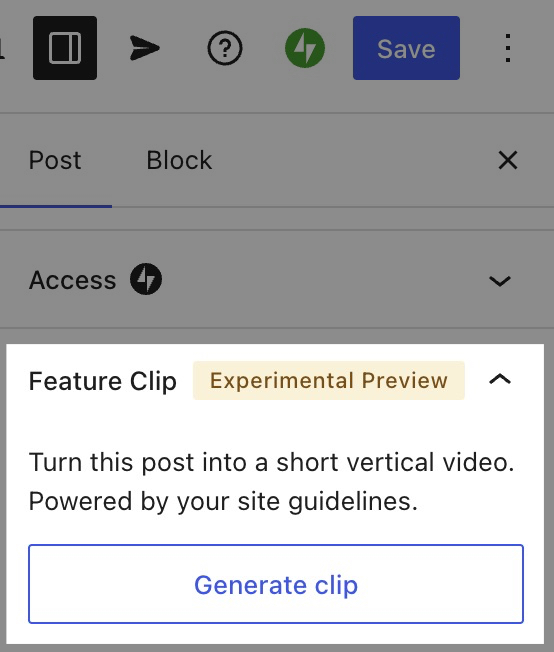
  3. Scroll down to the Feature Clip section.
  4. Click Generate Clip:
  5. Choose a style from the Style dropdown:
    • Cinematic: Create an 8-second mood clip with instrumental audio.
    • Highlights (coming soon): Build a 20-second recap clip using your post’s images and key points.
  6. Enter a custom prompt describing the video you’d like, or choose from one of the pre-made suggestions.
  7. Wait for the clip to generate. This can take 1 to 3 minutes.
  8. Once the video is created, it is automatically saved to your media library. Close the overlay by clicking the X in the top right corner.

Your clip is now visible in the Feature Clip section of the post settings sidebar.

What to expect from the experimental preview

Feature Clip is an early preview. Expect the feature to change as we gather feedback and improve the output.

  • Clip length: Cinematic clips are 8 seconds long. Longer clips are planned but not yet supported.
  • Aspect ratio: Clips are vertical (9:16) only, sized for Reels, Shorts, and TikTok.
  • Generation time: Each clip takes one to three minutes to generate. Keep the modal open while it generates (the video will be lost if the modal is closed before the video has finished generating).
  • Rate limit: You can generate up to 10 clips per site every 24 hours.
  • Content safety: Some prompts or post content may be blocked by content safety filters. If a generation is blocked, adjust the prompt or the post content and try again.

View your Feature Clips

Every clip you generate saves to your site’s Media Library automatically.

To locate your video clips:

  1. Visit your site’s dashboard.
  2. Navigate to Media → Library.
  3. Your most recent clips will be shown first. You can change the “All media files” dropdown to Video to show only your site’s video files.
  4. Select your video to view its details, copy its URL, or download the file.

Sharing, downloading, and adding your clip to a post

After a clip has been generated, the Feature Clip section in the post settings sidebar gives you several options:

  • Share opens your device’s share menu, where you can send the clip via AirDrop, Messages, Mail, Notes, or copy it to share elsewhere.
  • Share to Instagram publishes the clip as an Instagram Reel if you have Instagram connected through Jetpack Social.
  • Add to post inserts a Video block into your post with the clip embedded.
  • Regenerate reopens the Jetpack AI overlay so you can create a new clip.

For developers

Developers who want to control whether the Feature Clip option appears on their site can use the jetpack_image_studio_can_generate_video_clips filter. See How to use actions and filters to customize Jetpack for general guidance on working with Jetpack hooks.

Still need help?

Please contact support. We’re happy to advise.

Privacy

Feature Clip uses Google Veo to generate video content. The post content is sent to the generation service to produce the clip. See the Jetpack AI privacy information for general Jetpack AI data handling.

Comments Off on Generate video clips from your posts with Jetpack AI

Jetpack VideoPress video stats

Check how popular your Jetpack VideoPress videos are, with Jetpack Stats.

Jetpack Stats, including video stats, are only available in the Jetpack plugin. If you’re using the individual VideoPress plugin and want stats for your videos, please install the Jetpack plugin as well.

Video views have their own section within the Jetpack Stats page under Stats → Traffic tab in your WP Admin.

Scroll down on the page to find the video stats section.

VideoPress stats display

Jetpack VideoPress videos on your site are listed by title, along with how many views a particular video has received.

  1. To view detailed stats for a video, click on the video’s title.
  2. Click on View details to view more detailed stats for all videos.
  • Impressions: The number of times a video was loaded on the page.
  • Hours watched: The total number of hours that the video has been watched by all viewers.
  • Views: The total number of how many times the video was played.

Please note this is the total number of views, even if one person watched a video multiple times. We record a single play while the page is open. If a person reloads the page or revisits the page later and watches it again, then that would count as a separate play.

Retention rate calculation

The Retention Rate is calculated by the percentage of a video’s total duration that is watched on average per view.

rate = ( ( watch_time / views ) / duration ) * 100

Still need help?

Please contact support. We’re happy to advise.

Comments Off on Jetpack VideoPress video stats

Add chapters to your Jetpack VideoPress videos

Chapters are a great way to split up longer videos and organize them into different sections. Your visitors can see what each section is about and skip to their favorite parts.

How to add chapters to your VideoPress videos

  1. Upload a video via the VideoPress block.
  2. Click the “Done” button once it is finished uploading.
  3. Navigate to the block settings for the video in the editor sidebar. Make sure you’ve clicked on the VideoPress block in the editor section of the screen, then click the ‘cog’ icon below the Publish button to make the block settings appear.
  4. In the Description box, add a list of timestamps in minutes and seconds, along with corresponding chapter titles.
  5. Make sure that the first timestamp starts with 00:00.
  6. Add at least three chapter entries, in consecutive order, with at least 10-second intervals between each.

For example:

00:00 Intro
00:24 Mountains arise
02:38 Coming back home
03:04 Credits

Still need help?

Please contact support. We’re happy to advise.

Comments Off on Add chapters to your Jetpack VideoPress videos

Add subtitles to your Jetpack VideoPress videos

Add subtitles or captions to your VideoPress videos by uploading a .vtt or .srt file, or by using auto-generated subtitles.

VideoPress is available with Jetpack Complete, Jetpack Security, and the standalone VideoPress plan. You can upgrade your plan to access VideoPress features.

Prerequisites

Before you begin, make sure the following requirements are met:

  • Jetpack is installed and connected to your WordPress.com account.
  • Your site has an active Jetpack Complete, Jetpack Security, or standalone VideoPress plan.
  • You have a subtitle file in .vtt (Web Video Text Tracks) or .srt (SubRip Text) format, or you plan to use auto-generated subtitles.

Adding subtitles or captions to your VideoPress videos makes them accessible to a wider audience. You can upload a subtitle file in .vtt (Web Video Text Tracks) or .srt (SubRip Text) format, or let VideoPress generate subtitles automatically. SRT files are automatically converted to .vtt format on upload.

You can upload a .vtt or .srt file at any time to override auto-generated subtitles.

Auto-generated subtitles

New uploads automatically receive auto-generated subtitles. This applies to new uploads only; videos uploaded before this feature went live are not retroactively transcribed. Videos without an audio track do not receive a transcript.

You can still upload a .vtt or .srt file to add or override auto-generated subtitles at any time.

To access auto-generated subtitles on an eligible video:

  1. Click on the video player’s Settings.
  2. Select Captions.
  3. Select Auto-Generated.

Turn off auto-generated subtitles

Site owners can turn off the auto-generated subtitles for the whole site. When this setting is off, new video uploads no longer generate subtitles automatically. Previously generated subtitles will still be present on existing videos. To remove them, edit the video’s subtitle tracks individually. You can still add subtitle files manually to any video at any time.

To turn off auto-generated subtitles:

  1. In WP Admin, go to Jetpack → VideoPress.
  2. Open the Settings tab.
  3. Toggle off Automatically generate subtitles for new videos.

Add a subtitle file to a VideoPress video

You can upload a .vtt or .srt file to add subtitles or captions to any VideoPress video. If you upload an .srt file, VideoPress automatically converts it to .vtt format. Follow these steps to add a subtitle file:

  1. Upload your video using the VideoPress block.
  2. Click on the Text Tracks icon in the block toolbar
  3. Click Upload track to upload your .vtt or .srt file. The Label and Source Language fields are automatically populated if you leave them empty.
  4. Click Save.
  5. Preview your post to verify the subtitles appear correctly. The subtitles’ menu should be visible in the VideoPress player, with your subtitles track listed as an option.

Turn on captions on the published page

Captions and subtitles are turned off by default when someone watches your video on the published page. Uploading a subtitle file does not make captions appear automatically. Each viewer chooses whether to display them, and the same is true when you preview your own published page.

To turn captions on while watching a video:

  1. Click the Settings icon in the video player.
  2. Click Captions.
  3. Select the subtitle track you want to display.

These steps apply to both the subtitle files you upload and auto-generated captions. If you do not see your subtitles after publishing, your file is still working correctly. Open the Settings menu and select your track to display it.

Subtitle file formats

VideoPress accepts .vtt (Web Video Text Tracks) and .srt (SubRip Text) files. SRT files are automatically converted to .vtt format on upload.

Subtitles limitations

You cannot associate a subtitle file directly with a video in the Media Library. You must add the VideoPress block first. However, when you upload a track file to the video using the steps above, it is associated with the media file itself. If you reuse the video file elsewhere, the track is already in place.

Customize caption appearance

Viewers can use the Captions Settings menu in the VideoPress player on the front end of the site to customize the appearance of the subtitles or captions.

Privacy information

Subtitle processing may involve transmitting audio data for transcription. For details on how VideoPress handles data, refer to the Jetpack privacy information page. This section is pending review by the DRI/Editor-in-Chief.

Still need help?

Please contact support. We’re happy to advise.

Related articles

The following articles cover other VideoPress features and setup tasks:

Comments Off on Add subtitles to your Jetpack VideoPress videos

Add a Video Using the Classic Editor

Upload videos from your computer to be hosted on our servers, rather than on your web server, using the WordPress Classic Editor.

To learn more about adding HD, ad-free video hosting to your WordPress site, check out Jetpack VideoPress.

This page explains how to use Jetpack VideoPress with the Classic Editor plugin. However, Jetpack offers only limited support for it.

We recommend switching to the Block Editor for better compatibility, an improved editing experience, and full access to VideoPress features. Learn more about using the Jetpack VideoPress Block.

Insert a video

Uploading videos via the Classic Editor requires the Jetpack plugin. It will not work when using the standalone Jetpack VideoPress plugin.

To add a video to a post, follow these instructions:

  1. In the post editor, position the cursor where you’d like the video to be displayed.
  2. Click the “Add Media” button to bring up the Media Library view.
  3. From that view, select your video, or upload a new one.

Jetpack’s video hosting supports MP4 (.mp4, .m4v), QuickTime movies (.mov), Windows Media Video (.wmv), Audio Video Interleave (.avi), MPEG (.mpg), 3GPP ( .3gp ) and 3GPP2 ( .3g2 ).

The VideoPress seekbar automatically changes color for a better video-watching experience. The color-changing effect can be activated and deactivated by appending the useAverageColor parameter to the VideoPress video URL and setting it to true or false.

Adjust video settings

After embedding a video, adjust its settings:

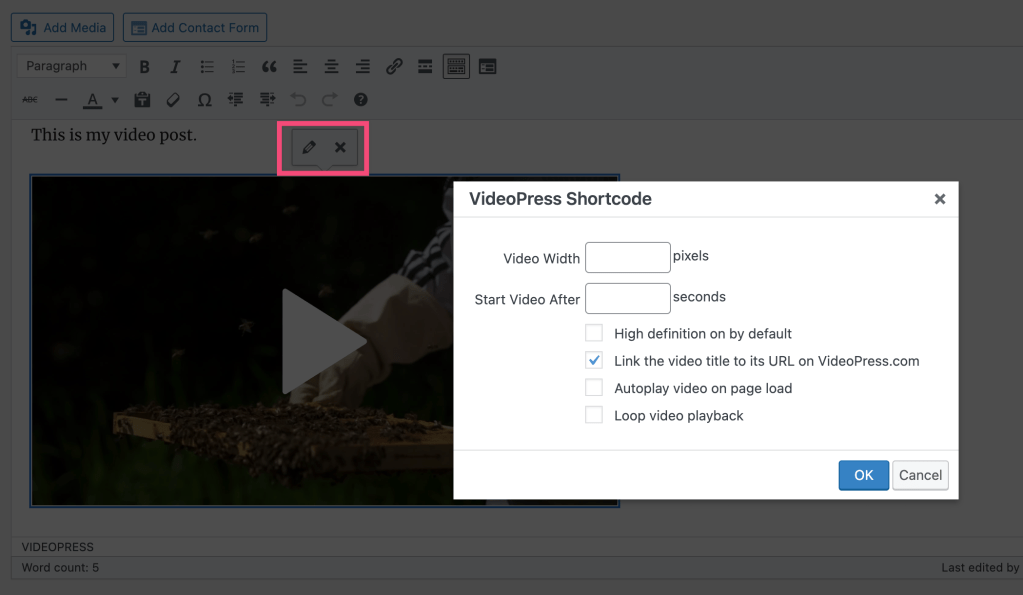
  1. Select the video.
  2. Click the pencil icon
  3. Update the settings as needed. This includes:
    • Adjusting the video width in pixels
    • Selecting a custom time to start the video
    • High definition by default
    • Link the video title to its URL on VideoPress.com (if this is unselected, the title only will appear, without a link)
    • Autoplay video on page load
    • Loop video playback
A video loaded via Classic Editor, with the settings modal open.

Adjust sharing settings

By default, your visitors can click the sharing icon in the top right of the video player to reveal the following sharing and embedding options:

  • Direct URL to the video (at VideoPress.com)
  • Start time
  • Loop
  • Autoplay
  • HTML Embed

To disable sharing:

  1. Go to the Media Library.
  2. Select the video.
  3. Uncheck “Display share menu and allow viewers to embed or download this video.”

Note: Disabling the sharing options removes the functionality from the video player, but it is still possible to download the video from your browser. We take reasonable steps to prevent embedding on other sites by hiding the sharing options, which should stop most attempts.

Video stats

All videos come with stats tracking, which can be viewed within your Jetpack Stats. You can scroll down and find the “Videos” stats.

Still need help?

Please contact support. We’re happy to advise.

Comments Off on Add a Video Using the Classic Editor

Add a VideoPress video using the Block Editor

Insert your videos directly into posts and pages on your website; they’ll be automatically uploaded to VideoPress hosting.

Jetpack VideoPress is free to try, and you can upload and host one video (up to 1 GB in size) at no cost. If you use the Classic Editor plugin, please refer to this guide instead: Add a Video Using the Classic Editor.

The VideoPress block is a part of the Jetpack Blocks suite. See our Jetpack Blocks article to learn about the available blocks and how to activate them.

Jetpack Blocks require the Block Editor (also referred to as the Gutenberg editor). If you’ve installed the Classic Editor plugin, you have a few options:

  • Deactivate the Classic Editor: Go to PluginsInstalled Plugins in your WP Admin and deactivate the Classic Editor plugin.
  • Enable both editors: If you prefer flexibility, navigate to Settings → Writing in your WP Admin (not the menu under Jetpack settings). Set Allow users to switch editors to Yes. You will only see these options if you have the Classic Editor plugin installed and active.

Some custom themes or plugins may prevent you from using the Block Editor. In that case, please contact the support team for the plugin or theme for further assistance.

For more details, see Using Blocks and the Classic Editor.

Insert the VideoPress block into a post or page

  1. Add the VideoPress block by searching for and selecting it within the block selector on a post or page on your site. Alternatively, you can type /videopress directly into the content of the page or post, then select the block from the drop-down that appears. To unlock all VideoPress features, please be sure to select the VideoPress block and not the Video block.
Screenshot of the block selector dropdown options. When searching for videopress, both the VideoPress block and the Video block will show up. Choose `VideoPress`
Adding the VideoPress Block from the block selector.

Select a video

  1. Drag your video directly to the block within your post or page to upload it. Alternatively, you can use one of the three options: Upload, Media Library, or Insert from URL. Each option is outlined below:
  • Upload: Upload a new video file from your computer. See our article Uploading a Video to Jetpack VideoPress for recommendations on file size and format for your videos.
  • Media Library: Select any VideoPress file that’s already been uploaded to your library.
  • Insert from URL: Insert the video URL directly.
  1. Once the video successfully uploads, you’ll see the ‘Upload complete!’ notification. When you are happy with your Video Title and Thumbnail, click Done and you’ll see your video embedded into your post or page. From there, you’ll be able to set a caption for your video and access the Block Toolbar.

Adjust your video’s settings

  1. Access video settings options either from the VideoPress Block toolbar or the block’s sidebar settings for maximum control over how your video plays, and for whom. These different settings areas are outlined below.

The VideoPress Block toolbar will hover above the block in the editor.

Videopress block toolbar, showing three icons: alignment, image, text tracks.
A screenshot of the VideoPress block toolbar.

Every WordPress block has settings available in the editor sidebar. If you do not see the sidebar, click the ‘cog’ icon next to the Publish button, and it will appear. These settings include adjusting how your video plays for visitors (playback settings), progress bar color customization, and privacy options.

Publish button, with the cog wheel next to it, opening up the Block settings.
A screenshot of where to find the WordPress Block editor settings on a post or page

Video settings

Video alignment

Change the alignment of your video to left justify, center justified, or right justified in the VideoPress Block toolbar.

Add video captions or subtitles

Add text tracks (captions or subtitles) in the VideoPress Block toolbar.

Edit video poster image

In the VideoPress Block toolbar, edit the poster image to change the thumbnail image that will be displayed before a video is played:

  • Choose an appealing image that’s most indicative of the video’s content.
  • While there isn’t a minimum required size for your poster image, we recommend that the image be at least the size of your video.
  • For example, if your video is a 1080p video, you should use a poster image that is 1920 x 1080 pixels.

Video title and description

Title and description:

  • can be modified in the block sidebar settings
  • can improve SEO (search engine optimization) and accessibility
  • can also be used to add chapters to your video.

Video playback Settings

The following video playback settings can be modified in the block sidebar settings:

  • Autoplay: Set your video to automatically play when someone visits your page or post. Some browsers do not respect this setting. You may need to enable mute for autoplay to work in those instances.
  • Loop: Choose if the video repeats automatically after it plays through. 
  • Muted: Choose if the video has sound when it plays. Users can still unmute the video from the player controls. It’s recommended to use the muted option if you choose to have your video autoplay.
  • Show Controls: Show or hide the playback controls on the video. This option is turned on by default.
  • Play Inline: Play your video inline within the element’s playback area. Not selecting this option doesn’t mean that your video will always be played fullscreen.

VideoPress Progress Bar Colors

Adjust the color of the VideoPress progress bar in the block sidebar settings:

  1. VideoPress will automatically default to the Dynamic color setting, which will make the progress bar adapt to the video as it plays.
  2. If you toggle off Dynamic color, you’ll see three color sections to change: Main, Loaded, and Progress.
  3. After you select your desired Progress Bar colors, the player on the page will update automatically.
  4. Preview the colors you have selected before publishing or updating a page or post.
  5. When you publish or update your page or post, these color changes will be live on your selected video.

Video privacy and rating

Video privacy and ratings can be adjusted in the sidebar block settings:

  • Rating: Select a rating for the video, based on its content.
  • Privacy: Decide who gets to see your videos: site members only (private), or all visitors to your site (public). For more information, check out our VideoPress: Privacy article.
  • Allow Download: Control whether the VideoPress player should include the option for users to download the video.

Advanced video player settings

Add a CSS class to your block in the Advanced section of the sidebar block settings, so you can write custom CSS and style the block as you see fit.

The VideoPress video player is embedded in an iframe, meaning it’s not possible to style the video player itself. Only the <div> which contains the video player can be styled with CSS.

You can also add an HTML anchor to the block, to create a link directly to that section of the page.

Adaptive streaming and VideoPress

VideoPress supports adaptive streaming, which enables faster video playback by automatically adjusting the quality based on the viewer’s bandwidth and screen size. However, viewers can still manually select their preferred video quality from the video player’s menu.

To learn more about other VideoPress options, please visit this guide.

Why can’t I find the VideoPress block?

If you can’t find the Jetpack VideoPress block, check the following:

Troubleshooting

If you’re having trouble with videos, please refer to the article on Uploading a Video to Jetpack VideoPress or Troubleshooting Video Hosting Issues.

Still need help?

Please contact support. We’re happy to advise.

Comments Off on Add a VideoPress video using the Block Editor
  • Enter your email address to receive news and updates from Jetpack

  • Join 99.3K other subscribers
  • Browse by Topic